The Matching-Colour Trap in Plant Combinations
Plant combinations need more than matching flower colours. Pair plant shape, foliage and bloom tone to create a garden planting that feels coherent and lively.
Plant combinations can feel flat when every flower colour matches. For a more lively planting, let foliage, flower form and plant shape do some of the connecting, then use colour to add another layer.
Start with plant shape, not a colour scheme
Before choosing blooms, decide what kind of structure the planting needs. A narrow flower spike, a rounded mound and an arching spray each make a different mark. Combining distinct forms can give a small group definition without adding more colours.
Choose a simple role for each plant:
- Upright: Foxglove or salvia provides a vertical accent. If the group has no upward line, add one upright plant; if it already feels spiky, choose a mound instead.
- Mounded: Hardy geranium or a compact shrub creates a rounded mass. If the planting needs a solid middle layer, use a mound; if it looks crowded, leave space rather than adding another.
- Spreading: Creeping thyme can soften an edge. If the front looks abrupt, consider a spreading plant; if the edge is already covered, avoid duplicating it.
- Airy: Fine-leaved grass or fennel lets neighbouring plants show through. If dense foliage dominates, add an airy form; if the group already looks loose, choose a more solid shape.
These are visual roles, not fixed categories. A plant may change shape as it grows or sends up flower stems, so check its mature form and suitability for your garden before assigning it a place.
Let foliage carry the planting between blooms
Leaves remain part of the composition when flowers are scarce. Broad, smooth foliage creates a solid patch; fine, divided leaves look lighter and more intricate. Silvery, dark or variegated leaves add contrast even when little is flowering.
Compare foliage in nursery pots or in photographs that show the whole plant. If every leaf is broad and similar, introduce a finer texture; if several patterns compete, favour a simpler leaf nearby. A broad-leaved plant beside ferny foliage can make both easier to distinguish.
Use leaf colour as part of the relationship, rather than as a substitute for blooms. Dark foliage can anchor pale flowers, while silvery leaves can sit comfortably beside purple, pink or white. Give a variegated plant room to register; if several high-contrast patterns are already present, choose a calmer neighbour.
Repeat flower forms to make a gentle rhythm
Notice whether flowers appear as spikes, flat heads, daisies, bells, globes or loose sprays. Repeating one form gives a planting continuity. Adding a contrasting form creates a pause for the eye. A useful starting point is one dominant flower shape and one contrasting shape.
Rounded flower heads can echo one another, while a few upright spikes interrupt the repetition. Small daisy-like blooms may soften the transition. The colours need not match exactly if shape or foliage connects the plants.
Flower form also affects the way colour reads. A deep shade in a dense head can feel bold; the same shade in scattered small blooms may seem lighter. Consider how much colour there is and how it is distributed, not only the name on a plant label.
Add colour after shape and foliage
Once the forms feel balanced, decide how colour should link the plants. A restrained palette might pair white flowers with blue-purple blooms and green foliage. Alternatively, keep flowers quieter and let contrasting leaves do more of the work.
A colour wheel can suggest possibilities, but it is not a rulebook. Opposite colours may create lively contrast; neighbouring colours may feel gentler. The result also depends on the flowers, surrounding materials and light. A few nursery pots can help you judge whether the combination feels too uniform or too busy.
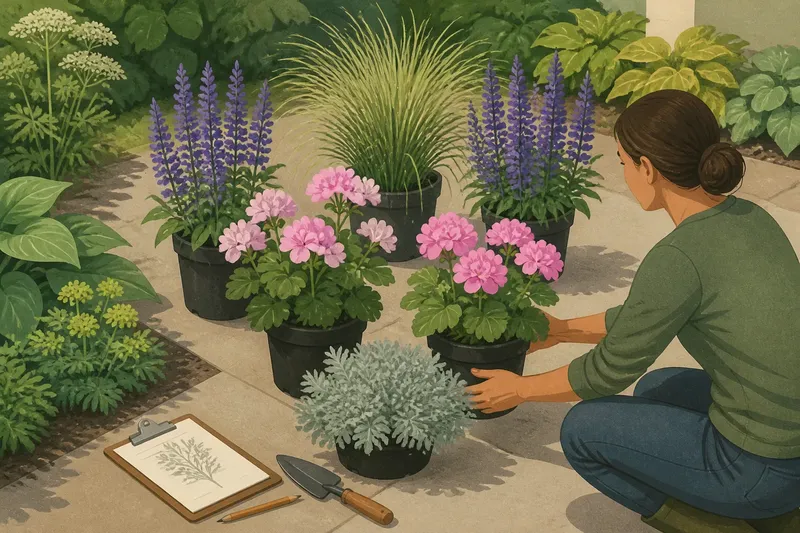
Say you have blue-purple salvia and pale pink hardy geranium in separate nursery pots, and the group looks too much like a row. You add a low, silver-leaved plant near the front and place a fine-leaved grass behind the flowers. The expected result is a clearer difference in texture and height, while pink and purple still connect the blooms.
Questions gardeners ask about matching flower colours?
Should every flower colour match?
No. Repeated foliage, related flower shapes or a shared plant height can connect blooms in different colours. If the colours seem unrelated, look for one of those features to repeat.
How many plant shapes should I combine?
Begin with one dominant form and one or two contrasts. If the group feels busy, remove a form rather than adding another colour or shape.
What if the flowers bloom at different times?
Choose plants with foliage and outlines that remain clear between flowering periods. Check likely flowering seasons, then favour a useful mix of leaf textures and forms so the group still has structure when one bloom fades.
Can plants with very different colours work together?
Yes, if another feature links them. Repeated leaf shapes, a shared flower form or a clear contrast in height can help distinct colours belong in one planting.
Check the combination before planting
Set the nursery pots in their intended positions and inspect what the plants contribute:
- If every plant has a similar outline, move one pot aside and try an upright or spreading form; if the shapes already contrast, keep the arrangement.
- If all the leaves look broad and solid, place a fine-leaved plant beside them; if the foliage already varies clearly, do not add another texture just for variety.
- If variegated leaves sit beside several strong patterns, move one patterned plant elsewhere; if the foliage reads clearly, leave it in place.
- If one flower shape dominates, try a contrasting form; if the repeated shape gives the group a clear rhythm, keep the repetition.
- If the flower colours look disconnected, repeat a leaf colour or flower form; if foliage and shape already link them, let the colours differ.
- If a plant’s mature size would crowd its neighbours, replace it with a more suitable option; if there is room for its expected spread, retain the position.
Imagine a gardener has three pots of blue-purple salvia lined up with three pots of pale pink hardy geranium, and the group looks like alternating blocks of colour. First, they move one salvia to the back, creating a loose cluster rather than a straight row. Next, they place a low silver-leaved plant at the front and a fine-leaved grass behind the flowers. They check the labels and find that the silver plant would spread too far for the available space, so they set it aside and use a smaller suitable option. The resulting arrangement keeps the pink and purple connection, adds a clearer change in texture and height, and avoids a plant likely to crowd its neighbours.
It is not worth chasing an exact colour match across every flower. Blooms change as they open and fade, and their appearance shifts with the light. A planting with varied shapes and foliage can accommodate those changes without relying on one precise shade.
When choosing plant combinations, start with the forms and foliage, then settle on flower colours. Check each plant’s mature size and garden suitability before planting; that practical detail can matter more than a perfect match between blooms.